
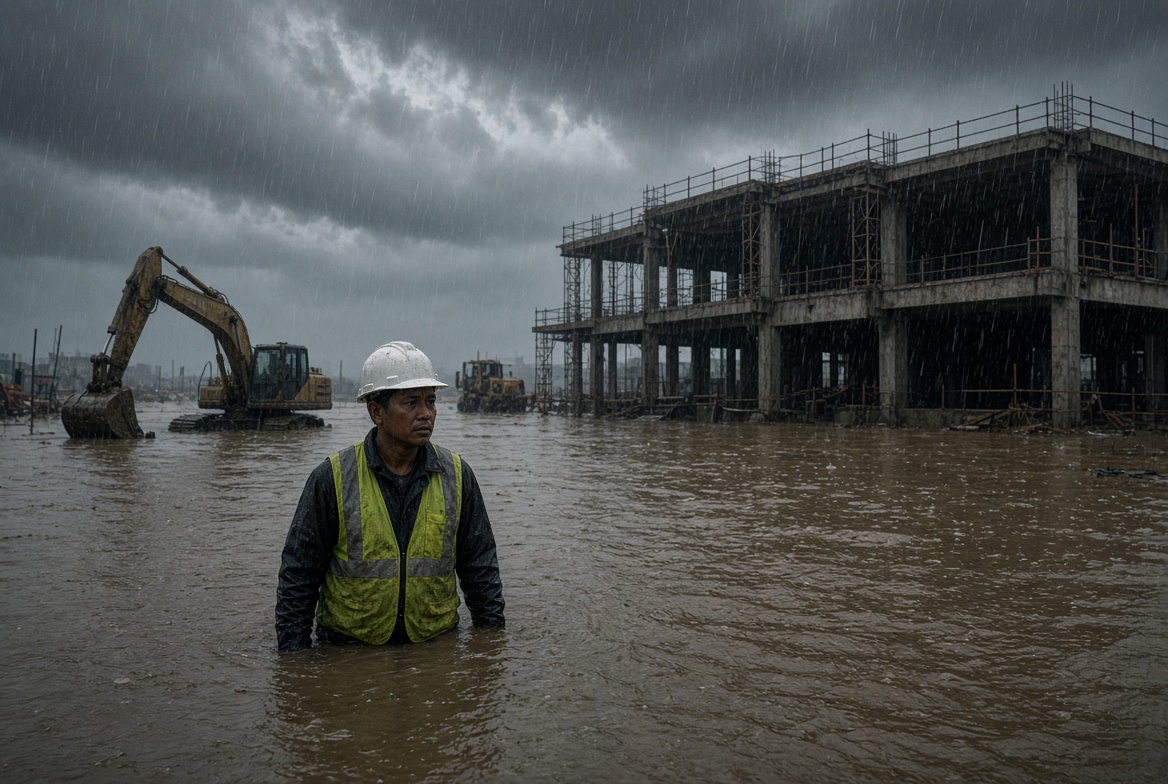
Few words appear more frequently in construction-delay discussions than:
“Force majeure.”
A project is delayed because of a typhoon.
Materials suddenly become unavailable.
A government order affects the project.
A major external event disrupts construction.
The contractor then attributes it to “force majeure.”
But saying the words does not automatically make a contractor legally excused from delay.
Under Philippine law, the mere occurrence of an extraordinary or difficult event is not enough. The circumstances, the contract, the cause of the delay, and the contractor’s own conduct may all matter in determining whether the contractor can be held responsible.
This distinction is particularly important in construction because projects are full of events that can affect progress. Some are genuinely beyond a party’s control. Others are foreseeable project risks that should have been anticipated, managed, or absorbed as part of the contractor’s obligations.
So when can a contractor legitimately invoke force majeure?
And when is “force majeure” simply being used as a convenient explanation for a delay that remains the contractor’s responsibility?
1. What Does Force Majeure Actually Mean Under Philippine Law?
The starting point is Article 1174 of the Civil Code.
Article 1174 provides that:
“Except in cases expressly specified by the law, or when it is otherwise declared by stipulation, or when the nature of the obligation requires the assumption of risk, no person shall be responsible for those events which could not be foreseen, or which, though foreseen, were inevitable.”
In Philippine jurisprudence, this principle is commonly discussed under the doctrine of fortuitous events, which is closely related to what construction contracts often describe as force majeure.
That distinction is worth remembering because “force majeure” is not a magic phrase that automatically excuses performance.
“Something unexpected happened” does not automatically mean “the contractor is legally excused.”
The legal analysis requires a closer look at what actually happened, whether the event satisfies the requirements recognized under Philippine law, and what the parties agreed in their construction contract.
2. The Four Requirements for a Fortuitous Event
In Philippine Realty and Holdings Corporation v. Ley Construction and Development Corporation (G.R. No. 165548 & No. 167879, June 13, 2011), the Supreme Court identified the requisites that must generally be present for a party to be exempt from liability under Article 1174:
- The cause of the breach must be independent of the debtor’s will.
- The event must be either unforeseeable or unavoidable.
- The event must be such as to render performance impossible in the normal manner.
- The debtor must be free from participation in, or aggravation of, the injury to the creditor.
These requirements are important because they prevent force majeure from becoming a blanket excuse for construction delays.
Consider the difference between these two situations:
A contractor encounters an extraordinary event that genuinely prevents the normal performance of the affected work, despite the contractor having acted properly and without contributing to the problem.
That is very different from a contractor who encounters an ordinary project difficulty, fails to prepare for it, and later describes the resulting delay as force majeure.
“The event matters. But so do causation, foreseeability, and the contractor’s own conduct.”
In construction, that is often where the real dispute begins.
3. A Bad Event Is Not Automatically a Force Majeure Event
Construction projects routinely encounter difficult conditions.
Heavy rain. Material shortages. Labor problems. Delayed deliveries. Permit issues. Difficult site conditions.
Some of these events may be serious.
But seriousness alone does not determine whether the event legally qualifies as a fortuitous event or force majeure.
The Supreme Court illustrated this point in MIAA v. ALA Industries Corporation (G.R. No. 147349, February 13, 2004), a case involving construction work at the Ninoy Aquino International Airport.
The Court rejected the argument that foreseeable difficulties and delays associated with the Christmas season could be treated as a fortuitous event. The important lesson is that an event that can reasonably be anticipated is not automatically transformed into force majeure simply because it caused inconvenience or difficulty.
For contractors, this distinction is critical.
A delay caused by an event that is genuinely beyond the contractor’s control is one thing.
A delay caused by poor planning, foreseeable procurement problems, inadequate manpower, or other risks the contractor was expected to manage is another.
“Difficulty is not the same thing as legal impossibility.”
That is why a contractor invoking force majeure should be prepared to explain not only what happened, but why the event actually prevented normal performance of the affected obligation.
4. Your Construction Contract May Define Force Majeure Differently
I have discussed Article 1174 but a contractor should not look only at Article 1174 of the Civil Code when assessing a force majeure issue.
The critical document to examine is the construction contract itself.
Construction contracts often contain their own definition of force majeure and may identify the events that can justify additional time or other forms of contractual relief. The construction contract must be read together with the law.
For example, in Philippine Charter Insurance Corporation v. Petroleum Distributors & Service Corporation (G.R. No. 180898, April 18, 2012), the construction contract for the Park ‘N Fly building expressly defined force majeure to include war, civil commotion and disturbance, acts of God, or other causes beyond the contractor’s control and without contributing fault on the contractor’s part.
That contractual language mattered because the parties had already agreed on how delay risk would be treated before the dispute arose.
This is an important point for both owners and contractors.
The question is not simply, “Does Philippine law recognize force majeure?”
The accurate question is, “What would constitute force majeure under this particular contract as agreed by the parties?”
“Before invoking force majeure, read the force majeure clause in your contract.”
A construction contract may also establish procedures for requesting an extension of time, including deadlines for notifying the other party and requirements for explaining the delay.
Again, in Philippine Realty and Holdings Corporation v. Ley Construction and Development Corporation (G.R. No. 165548 & No. 167879, June 13, 2011), the construction agreements required the contractor to submit a written request for an extension within ten days after encountering a justifiable cause of delay. The contracts expressly included force majeure among the possible causes for an extension of time.
The case is a good reminder that identifying a potentially excusable event is only part of the process. The contractor must also consider what the contract requires in order to obtain the corresponding contractual relief.
5. The Contractor’s Own Conduct Can Defeat the Defense
One of the most important limitations on a force majeure defense is the contractor’s own conduct.
An extraordinary event may genuinely occur, but that does not automatically excuse a contractor if the contractor’s own negligence, misconduct, or other participation contributed to the loss or delay.
The Supreme Court’s decision in Nakpil & Sons is a powerful example.
In Juan F. Nakpil & Sons, and Juan F. Nakpil v. Court of Appeals (G.R. No. L-47851, October 3, 1986), the case involved the collapse of the Philippine Bar Association building following the August 2, 1968 earthquake.
The Court recognized the earthquake as a fortuitous event or act of God. But that did not end the inquiry.
The Court found that defects in the construction, deviations from the plans and specifications, inadequate workmanship, and deficiencies in the plans and specifications contributed to the building’s failure. Because human negligence had contributed to the damage, the parties could not escape liability simply by pointing to the earthquake as the immediate cause.
“There was an earthquake” is not a blanket excuse.
The same reasoning can matter in a delay dispute.
Suppose an extraordinary weather event affects a project.
The contractor may have a legitimate force majeure argument for the period actually affected by that event.
But if the contractor was already substantially behind schedule because of inadequate manpower, poor planning, or other reasons within its responsibility, the existence of the external event does not automatically erase those prior problems.
The legal question is ultimately one of causation as well as the application of the force majeure doctrine.
6. What About Material Shortages and Supply Problems?
This is another area where construction disputes become particularly interesting.
Contractors regularly encounter shortages, price movements, delayed deliveries, and procurement difficulties.
The instinctive reaction may be to say that these are external events and therefore should qualify as force majeure.
But the answer depends on the circumstances.
The case we have been discussing, Philippine Realty and Holdings Corporation v. Ley Construction and Development Corporation (G.R. No. 165548 & No. 167879, June 13, 2011) is particularly instructive because the contractor sought extensions of time based on, among other things, shortages of cement and construction supplies.
The Supreme Court agreed that the shortage in supplies and cement could be characterized as force majeure under Article 1174 in the circumstances of that case.
That does not mean every material shortage automatically qualifies as force majeure.
The better question is whether the particular shortage satisfies the legal requirements, whether the contract allocates the risk differently, whether the shortage actually prevented normal performance, and whether the contractor did what could reasonably be expected to address the problem.
“A supply problem may be deemed a force majeure event—but it is not automatic. The circumstances of the case must justify it.”
7. Force Majeure Does Not Mean Every Consequence Is Excused
Another common misunderstanding is that once a force majeure event occurs, the contractor is automatically excused from every consequence that follows.
That is too broad.
The contractor still has to connect the event to the particular obligation that could not be performed.
For example, a typhoon may prevent certain site activities for a particular period.
That does not necessarily mean every activity on the project became impossible for the same period.
Likewise, a supply shortage affecting one material does not necessarily explain every day of project delay.
This is why delay analysis in construction can become much more complicated than simply counting the number of days between the contractual completion date and the actual completion date.
The parties may need to examine when the event occurred, what work it affected, how long the effect lasted, whether other causes contributed to the delay, and what extension-of-time mechanism the contract provides.
“The event, its effect, and the contractual consequence are three separate questions.”
8. Notice and Extension of Time Can Be Just as Important as the Event Itself
Even when a contractor has a legitimate basis for invoking force majeure, the contract may require the contractor to notify the owner within a specified period and to request an extension of time in a particular manner.
This is an important distinction between having a potentially valid excuse for delay and actually obtaining contractual relief for that delay.
We mentioned that in Philippine Realty and Holdings Corporation v. Ley Construction and Development Corporation (G.R. No. 165548 & No. 167879, June 13, 2011), the construction agreements contained a procedure requiring the contractor to submit a written request for an extension within ten days after encountering a justifiable cause of delay.
That requirement illustrates a practical point that contractors should keep in mind: even if the underlying event may qualify as force majeure, the contract may still require timely notice and compliance with its extension-of-time procedure.
For owners, this is equally important.
A force majeure claim should not simply be accepted because the contractor identifies an external event. The owner should also examine whether the contractor complied with the contractual requirements for invoking the event and requesting the relief being claimed.
“A legitimate event can still become a disputed claim if the contractual procedure is ignored.”
9. Force Majeure Is Different From Ordinary Construction Risk
One of the most useful ways to understand force majeure is to distinguish truly external events from ordinary risks that form part of construction.
A contractor is generally expected to manage the ordinary challenges that come with running a construction project:
- ordinary procurement and ordering decisions
- inadequate manpower
- poor project planning
- ordinary scheduling problems
- failure to coordinate subcontractors
- foreseeable site logistics issues
- ordinary business and cash-flow difficulties
These problems may be serious, expensive, or frustrating. But seriousness alone does not turn an ordinary project risk into a force majeure event.
Moreover, a contract may allocate particular risks between the parties, which is why a careful review of the force majeure and extension-of-time provisions is so important.
“Not every difficult event is a force majeure event. Construction risk and force majeure are not the same thing.”
10. What Should a Contractor Actually Prove?
A contractor making a force majeure claim should be prepared to answer several basic questions:
- What exactly happened?
- When did it happen?
- Was the event outside the contractor’s control?
- Was it unforeseeable or unavoidable under the applicable standard?
- How did it actually prevent or affect normal performance?
- Which activities were affected?
- For how long?
- Did anything within the contractor’s own control also contribute to the delay?
- What does the contract say about force majeure and extensions of time?
- Was the required notice given within the contractual period?
These questions are important because a force majeure claim is ultimately about more than the existence of an extraordinary event.
It is about establishing a legally and contractually recognizable connection between the event and the performance that could not be completed in the ordinary manner.
“A force majeure claim needs a story of causation—not just a story about the event.”
Final Thought
Force majeure is not a magic phrase.
A contractor cannot automatically escape responsibility simply because a typhoon, shortage, government action, or other difficult event occurred during the project.
At the same time, owners should not automatically reject a force majeure claim simply because a project was delayed.
The proper analysis is more disciplined.
What happened?
Did it satisfy the legal requirements?
Did it actually cause the affected delay?
What does the contract say?
Did the contractor comply with the required notice and extension procedures?
Did anything within the contractor’s own control contribute to the problem?
Those questions may take more work than simply pointing to an extraordinary event. But that is precisely what makes construction disputes about force majeure a matter of legal and project analysis rather than a simple excuse for delay.
In construction, the strongest force majeure claim is not necessarily the one involving the most dramatic event.
It is the one where the contract, the facts, the causation, and the evidence all point in the same direction.
Related Articles
- Liquidated Damages: Why Delay Is More Complicated Than It Looks
- Owner-Caused Delay: What Can a Contractor Actually Claim?
- Why Contractors Should Read Their Construction Contract Before Signing It
- What Contractors Should Understand About CIAC Arbitration
Dealing With a Construction Delay due to Force Majeure?
If your project has been affected by severe weather, government action, material shortages, supply problems, or another event that may have affected your contractual obligations, it is important to assess the situation against both the contract and the applicable legal standards before assuming that the delay is excused.
If you are dealing with a force majeure claim, an extension-of-time issue, liquidated damages, or another construction delay dispute, you may send an inquiry below for a clearer assessment of your position.