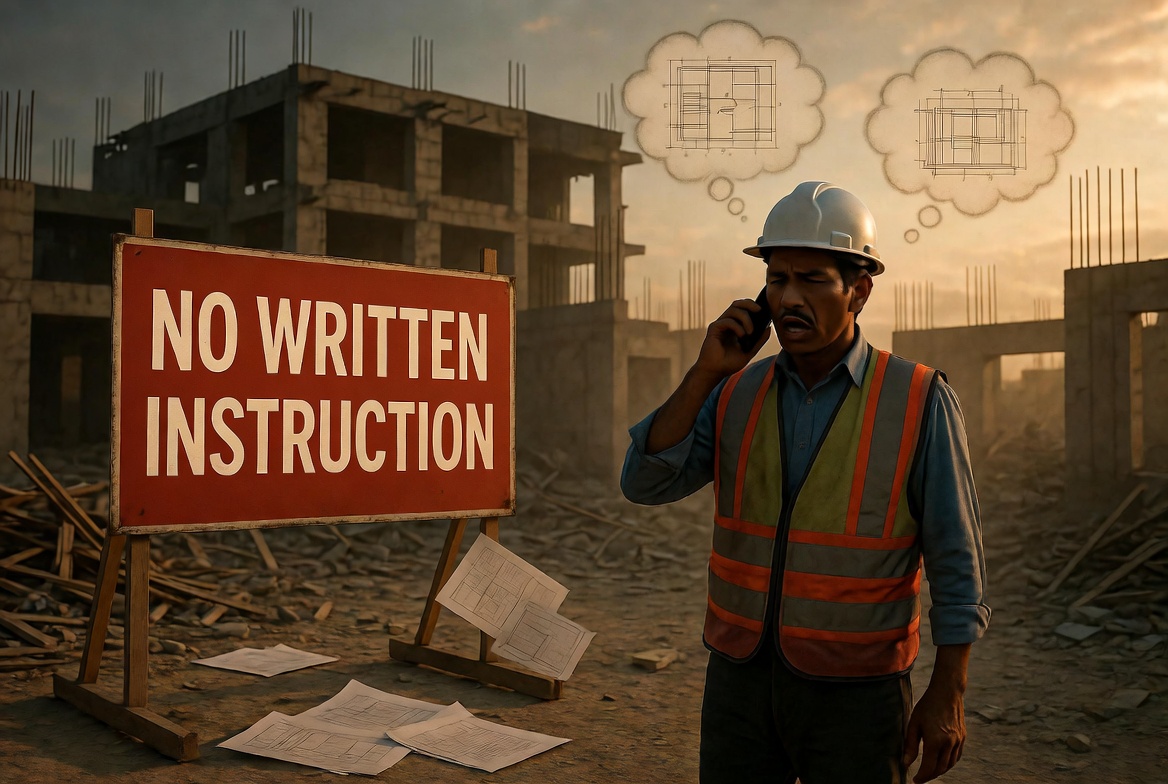
One of the most common habits in construction projects is reliance on verbal instructions.
A discussion happens on site.
An adjustment is requested.
A direction is given quickly during coordination.
At the time, everyone may understand what is being discussed.
“Okay, klaro naman. Gawin na yan.”
The problem usually appears much later — especially once delays, variation costs, payment issues, or responsibility disputes begin arising.
At that point, verbal instructions suddenly become very difficult to prove clearly.
1. Construction Projects Move Quickly
One reason verbal instructions are common is because construction projects operate under constant pressure.
People are trying to:
- maintain progress
- solve site problems
- coordinate trades
- avoid delays
- keep work moving
Because of this, discussions often happen informally during meetings, calls, or site walks.
In many projects, parties assume formal paperwork can simply follow later.
2. Problems Usually Appear Months Later
At the beginning, verbal instructions may not seem dangerous.
The issue usually appears later once:
- billing disputes arise
- delays occur
- variation costs increase
- schedules become affected
- responsibility becomes contested
At that stage, parties often begin asking:
- What exactly was instructed?
- Was the instruction authorized?
- Was additional cost approved?
- Was additional time discussed?
- Was there written confirmation?
“Kapag may dispute na, saka nagiging problema ang verbal instructions.”
3. Memory Becomes Unreliable During Disputes
One of the realities in construction disputes is that people often remember events differently once problems escalate.
Discussions that originally seemed clear suddenly become disputed months later.
This is especially common when projects involve:
- multiple meetings
- changing personnel
- fast-moving coordination
- overlapping instructions
- project pressure
Without written confirmation, reconstruction later becomes much more difficult.
“Minsan pareho kayong naniniwalang tama ang memory ninyo.”
4. Written Confirmation Changes Everything
One of the simplest ways to reduce confusion later is through written confirmation.
This does not always require lengthy formal letters.
In many situations, even a short follow-up email or message confirming the discussion can significantly improve clarity later on.
- instructions discussed
- scope adjustments
- agreed actions
- schedule impacts
- pending approvals
The goal is not to create unnecessary tension.
The goal is simply to create a reliable record while memories are still fresh.
“Mas madaling mag-document habang malinaw pa ang usapan.”
5. Documentation Is Not Necessarily About Distrust
Some contractors avoid written confirmations because they worry it may appear overly formal or confrontational.
But in reality, proper documentation is often part of good project management.
Construction projects involve:
- multiple parties
- changing site conditions
- overlapping responsibilities
- evolving instructions
- significant financial exposure
Clear documentation helps reduce misunderstandings before they become disputes.
“Hindi ibig sabihin na walang tiwala — ibig sabihin lang maayos ang records.”
6. Small Documentation Habits Create Stronger Positions
In many projects, strong documentation does not come from one dramatic effort.
It usually comes from small consistent habits over time.
- sending follow-up emails
- organizing instructions properly
- recording meeting discussions
- preserving project timelines
- documenting changes promptly
These habits may seem minor during the project itself.
But later, they often become extremely valuable once disagreements arise.
The earlier records are created, the easier it usually becomes to explain what actually happened.
7. The Bigger Problem Is Usually Delayed Documentation
One of the common patterns in construction disputes is that documentation only starts after the situation has already deteriorated.
At that stage:
- timelines may already be unclear
- instructions become disputed
- records become incomplete
- project impacts become difficult to reconstruct
“Kapag late na nagsimula ang documentation, mas mahirap nang buuin ang buong picture.”
Final Thought
Verbal instructions are common in construction projects.
Completely avoiding them may not always be realistic.
But relying purely on memory during complex projects creates significant risk once disputes begin appearing later on.
Simple documentation habits often become one of the strongest forms of protection in construction disputes.
Related Articles
- Why Construction Claims Fail Even When the Contractor Is Right?
- Variation Orders: Why Small Changes Become Big Disputes
- When Construction Problems Start Becoming Legal Disputes
Need Clarity on a Documentation Issue?
If your project involves disputed instructions, undocumented changes, or growing disagreements regarding what was actually agreed, it is usually better to assess the situation early before records become harder to reconstruct later on.
If you want a clearer view of your position, you may send an inquiry below.