
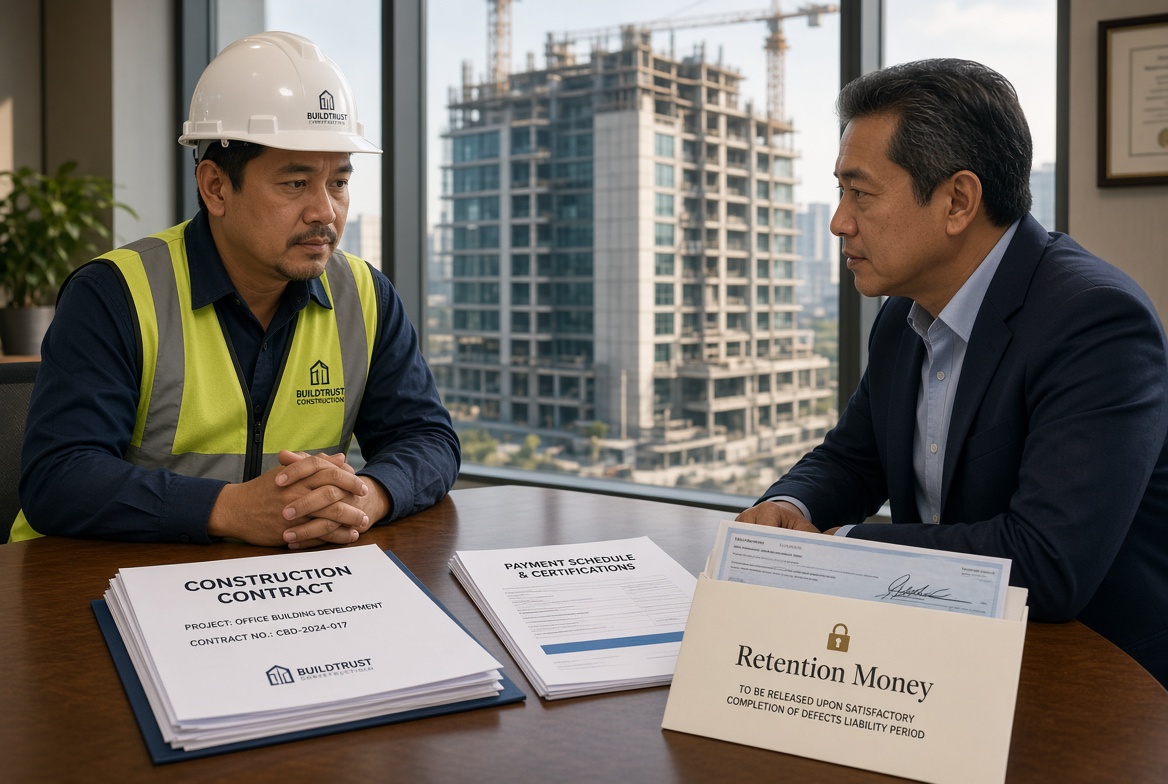
A construction project is nearing completion.
The walls are finished. The floors are installed. The fixtures are in place. The contractor is preparing for turnover.
But there is still one amount that has not been paid to the contractor.
Retention money.
For many contractors, retention represents a significant amount of money that has already been earned through months of construction work but remains in the owner’s hands.
For many owners, it provides an important layer of protection in case defects need to be corrected after the project reaches completion.
This creates an obvious question:
“When is the contractor actually entitled to get the retention money?”
The answer is not always simply “when the construction is finished.”
The timing and conditions for releasing retention money depend primarily on the construction contract and, in government projects, on the applicable procurement rules.
Philippine jurisprudence also recognizes retention money as a familiar feature of the construction industry, generally serving as security for the contractor’s performance of corrective work when necessary.
“Retention is not simply unpaid money. It is money withheld for a purpose.”
1. What Is Retention Money?
Retention money is generally a portion of the amount otherwise payable to a contractor that is withheld by the project owner for a specified period or until specified contractual conditions are satisfied.
Its purpose is to provide the owner with financial security for the contractor’s remaining obligations, particularly the correction of defects or deficiencies that may become apparent after the work has been completed or accepted.
The Supreme Court described this concept in Fort Bonifacio Development Corporation v. Manuel M. Domingo (G.R. No. 218341, December 7, 2022), explaining that retention money refers to a percentage of the contract price set aside by the project owner and retained for a specified period to guarantee the contractor’s performance of corrective works and services during the defect-liability period.
In that case, the private construction contract provided for retention of five percent of the contract price for one year after completion of the project.
That is an important point for private construction projects.
There is no general rule that every private construction contract in the Philippines must withhold exactly ten percent as retention money.
“For private construction projects, the percentage, period of retention, purpose, and conditions for release are ordinarily determined by the parties’ contract.”
2. Why Is Retention Money Withheld?
The basic idea is straightforward.
A construction project does not necessarily become completely risk-free the moment the contractor reaches physical completion.
Certain defects may only become apparent after the work has been completed and put into use.
A waterproofing problem may appear after heavy rain.
A finishing defect may become noticeable after occupancy.
A component may require adjustment or replacement.
A contractor may still have outstanding corrective work to perform.
Retention gives the owner a fund that can serve as security for those remaining obligations, subject to the terms of the contract.
In H.L. Carlos Construction, Inc. v. Marina Properties Corporation (G.R. No. 147614, January 29, 2004), the Supreme Court recognized the construction-industry practice of retaining ten percent of the contractor’s billings as security for corrective work that may become necessary, with the amount to be released after the applicable period, less the cost of corrective work where appropriate.
The practical purpose is therefore not to create a permanent discount against the contract price.
It is to give the owner security while the contractor’s remaining obligations are still capable of arising or being enforced under the agreement.
“Retention is security for performance—not a bonus for the owner.”
3. Ten Percent Is Common—but Be Careful About Assuming It Always Applies
The ten-percent figure appears frequently in Philippine construction contracts and is particularly familiar in government infrastructure projects.
But the legal treatment is different depending on the type of project.
For private construction, the parties generally determine the retention arrangement through their contract.
For government infrastructure procurement, however, the applicable procurement rules prescribe a specific retention mechanism.
Under Section 71.2.8 of the Implementing Rules and Regulations of Republic Act No. 12009, progress payments for infrastructure projects are subject to ten percent retention. The retention is made from each progress payment until fifty percent of the value of the works has been completed, subject to the further rules in the provision regarding satisfactory and timely performance.
The current government-procurement framework also allows the contractor, subject to the stated conditions, to request substitution of retention money with acceptable irrevocable standby letters of credit, bank guarantees, or callable-on-demand surety bonds of equivalent amount.
This distinction matters because rules applicable to a government infrastructure contract should not automatically be presented as if they were mandatory rules governing every private construction agreement.
“Ten percent may be familiar. Familiar does not mean universally mandatory.”
4. When Does Retention Money Become Due?
This is where retention becomes particularly important.
The fact that money has been withheld as retention does not necessarily mean that the contractor can demand it at any time.
The answer usually depends on the conditions that the parties agreed upon in the construction contract.
Those conditions may include completion of the works, issuance of an acceptance or completion certificate, expiration of a defect-liability or maintenance period, completion of corrective work, submission of required clearances or documents, or other requirements specified in the agreement.
This is why there is no single answer to the question, “When should retention be released?” that applies to every private construction project.
In the H.L. Carlos Construction case, the Supreme Court recognized retention money as a portion of the contract price withheld as security for corrective work and discussed its release after the applicable period.
The more important point for contractors and owners, however, is that the particular contract may establish specific conditions that must be satisfied before the retained amount becomes payable.
“Retention does not become due merely because the contractor asks for it. It becomes due when the applicable contractual conditions have been satisfied.”
5. Can an Owner Keep the Retention Money Because of Defects?
An owner may have a legitimate reason to retain money after completion if the contractor still has obligations covered by the retention arrangement.
For example, the contract may allow the owner to use part of the retention to cover the reasonable cost of correcting defects that the contractor was required to repair but failed to correct.
But that does not necessarily mean that an owner can simply retain the entire amount indefinitely because there is an unresolved complaint about the project.
The parties should look at the actual contractual provision: What defects are covered? What notice must be given? Does the contractor have an opportunity to correct the work? Can the owner deduct the actual cost of corrective work from the retention? When must the remaining balance be released?
These questions become particularly important when the amount being withheld is substantially greater than the reasonable cost of correcting the alleged defects.
“Retention is security for a purpose. It should not automatically become a fund for every dispute between owner and contractor.”
6. What If the Contractor Has Already Completed the Project?
Completion of construction is important, but it is not always the same thing as entitlement to immediate release of all retention money.
A contract may provide for a separate defect-liability or maintenance period following completion. During that period, the contractor may remain responsible for correcting covered defects, and the retention may continue to serve as security for those obligations.
The earlier stated Domingo case provides a useful illustration. The trade contract involved a five-percent retention that was to be withheld for one year after completion, with the defect-liability period running for twelve months from practical completion.
The case also shows why the exact contractual terms matter. The contractor’s project was terminated before completion because of defects and delay, another contractor was engaged to finish the remaining work, and the contract allowed expenses for completing the unfinished work to be deducted from the retention money.
The retention therefore did not operate as an unconditional amount that automatically belonged to the contractor upon the last day of physical work. Its treatment depended on the rights and obligations established by the trade contract.
“Look at the contract’s definition of completion—and what happens after completion.”
7. Government Construction Is Different
The discussion above is particularly important for private construction projects because the retention arrangement is generally a matter of contract.
Government infrastructure projects are different because the government procurement framework contains specific rules governing retention.
Under Republic Act No. 12009, the New Government Procurement Act, and its implementing rules, infrastructure-project progress payments are subject to retention at the prescribed rate. The current IRR provides for ten-percent retention from progress payments until fifty percent of the value of the works has been completed, subject to the conditions and subsequent rules in the provision.
The same provision states that the total retention money is due for release upon final acceptance of the works, subject to the applicable procurement rules and contractual requirements.
The current government rules should therefore not be confused with the arrangements found in a private construction contract. A private contract may use a different percentage, retention period, release mechanism, or other conditions, provided these provisions are not contrary to law.
“Government retention rules should not automatically be imported into private construction contracts, but they can be used as a benchmark.”
8. Can an Owner Withhold Retention Indefinitely?
No.
Retention is not intended to be an amount that the owner can simply keep forever.
But the legal basis for demanding its release depends on the contract and the circumstances of the project.
Once the contractual conditions for release have been satisfied, the contractor has a much stronger basis for demanding payment of the retained amount.
Conversely, if the contract provides that retention remains security during a specified defect-liability or maintenance period, the contractor cannot necessarily demand its immediate release merely because the physical construction has been completed.
The important point is that the owner should be able to identify the contractual or legal basis for continuing to withhold the money.
“Retention may be withheld for a reason. Once that reason no longer exists, the owner should be able to explain why the money is still being withheld.”
This is particularly important where the owner’s stated reason for withholding retention keeps changing—from unfinished work, to alleged defects, to unrelated claims against the contractor.
9. Can the Owner Deduct the Cost of Corrective Work?
Potentially, yes—but the answer depends on the contract and the circumstances.
A retention clause may expressly allow the owner to charge against the retention the reasonable cost of correcting covered defects or completing work that the contractor was obligated to perform but failed to complete.
In the Domingo case, the owner terminated the trade contract because of defects and delay, engaged another contractor to complete the remaining work, and deducted the expenses of completing the remaining work from the retention money in accordance with the trade contract.
The Supreme Court ultimately recognized that the retention money had been exhausted, among other things, by the costs of rectification and other liabilities covered by the circumstances of the case.
The lesson is not that every owner may simply deduct any amount it chooses from retention.
The lesson is that the contractual purpose of retention matters. Where the contract permits the owner to use retention for specified corrective work or other identified obligations, those provisions can have real legal consequences.
“If retention is being used to pay for corrective work, the contract should tell you why, how, and to what extent.”
10. Retention Is Not Automatically Available for Every Debt of the Contractor
Another issue arises when the contractor has debts to third parties.
Can a creditor of the contractor simply claim the retention money from the owner?
Again, the Domingo case is instructive on this point.
In that case, creditors of the contractor obtained garnishment orders involving the contractor’s receivables. The Supreme Court ultimately held that the contractor’s attempted assignment of a portion of the retention money could not be enforced against the project owner because the trade contract prohibited assignment without the owner’s written consent.
The case therefore illustrates an important principle: retention money remains subject to the contractual relationship from which the receivable arises. Questions concerning assignment, garnishment, and competing claims cannot necessarily be resolved simply by treating retention as ordinary cash already unconditionally payable to the contractor.
“Before treating retention as ordinary receivables, examine the contract that created the right to payment.”
11. What Should Contractors Check Before Demanding Release?
Before making a demand for release of retention, a contractor should review the contract carefully and determine whether the conditions for payment have actually been satisfied.
- Has the project reached the contractual stage of completion or final acceptance?
- Has the applicable defect-liability or maintenance period expired?
- Have all required corrective works been completed?
- Has the owner issued the required certificate, acceptance, or other confirmation—or is it being withheld unjustifiably?
- Are there documents, warranties, clearances, or other submissions still required?
- Does the contract authorize any deductions from the retention?
- Is the owner withholding the amount for a reason actually covered by the contract?
If those conditions have been satisfied and the owner continues to withhold the retention without a contractual or other legal basis, the contractor should consider making a formal written demand and identifying the specific provision that requires release. The contractor may then opt to pursue legal action through CIAC arbitration (if there is an arbitration clause in the contract or the parties agree to arbitration) or through the regular courts.
12. What Should Owners Check Before Releasing Retention?
Owners should take a similarly disciplined approach.
Retention should not be released simply because the contractor asks for it, but neither should it be held merely because the owner remains generally dissatisfied with the project.
- Confirm that the contractual release conditions have been met.
- Identify any genuine outstanding defects or corrective work.
- Check whether the contract permits a deduction and what procedure applies.
- Determine whether the amount being withheld corresponds to a legitimate contractual obligation.
- Release any amount that is properly due once the applicable conditions have been satisfied.
The goal should be the same as it was when the retention clause was created: to provide appropriate security while the contractor’s remaining obligations are outstanding, and to release the money once that security is no longer required under the agreement.
Final Thoughts
Retention money is easy to misunderstand.
To the contractor, it is money already earned but temporarily withheld.
To the owner, it is security that may be needed if defects or other outstanding obligations remain.
Both perspectives can be correct.
The important question is what the parties agreed, what the applicable law requires, and whether the contractual conditions for release have been satisfied.
For private construction projects, there is no universal rule requiring every contract to withhold the same percentage for the same period. The contract generally determines the retention arrangement.
For government infrastructure projects, specific procurement rules apply, including the retention provisions under the current implementing rules of Republic Act No. 12009.
Either way, retention should not become an afterthought.
“Retention is security, not a permanent withholding of the contractor’s money.”
A well-drafted retention provision should tell both parties what is being withheld, why it is being withheld, when it should be released, and what can properly be deducted from it.
That clarity can prevent a relatively straightforward payment mechanism from becoming another construction dispute.
Related Articles
- Progress Payments Should Follow Progress—Not Promises
- What to Do If You Are Not Paid in a Construction Project
- Why Contractors Should Read Their Construction Contract Before Signing It
- Why Construction Claims Fail Even When the Contractor Is Right
- Can a Contractor Stop Work for Non-Payment?
Have a Dispute Over Retention Money?
Whether you are a contractor waiting for the release of retention or an owner determining whether retention may properly be withheld or applied against corrective work, the answer usually starts with a careful review of the construction contract and the project’s actual circumstances.
If you are dealing with a retention dispute, unpaid balance, defective work, completion issue, or other construction payment problem, you may send an inquiry using the form below.