
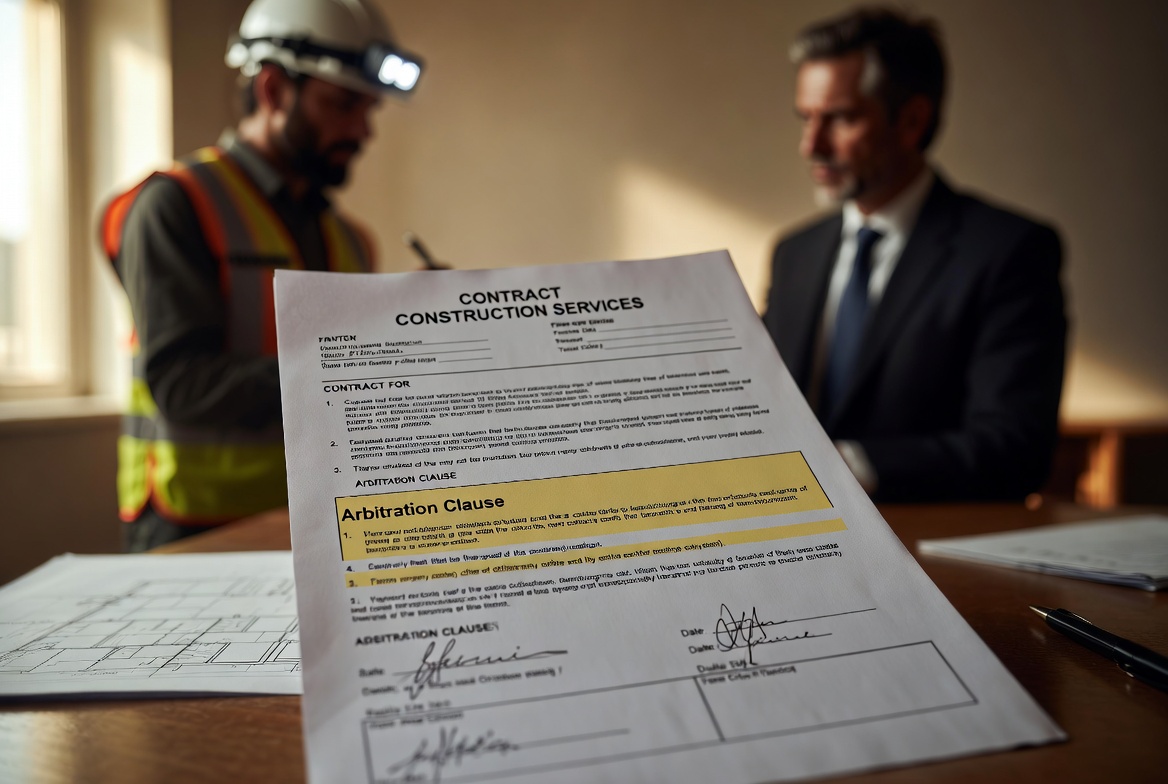
For many Filipinos, building a home is the realization of a lifelong dream.
Some save for years to build a retirement home.
Others return after working overseas to finally construct the family home they have always imagined.
Some build a vacation house where future memories will be made.
The excitement usually revolves around choosing the design, selecting finishes, and finding a contractor who can turn those plans into reality.
Very few people spend the same amount of time thinking about what happens if something goes wrong.
Ironically, one of the most important decisions is often found in a single clause buried within the construction contract—a clause many owners never notice until it is already too late.
“The most important clause in your construction contract may be the one you hope you’ll never need.”
1. Nobody Starts a Construction Project Expecting a Dispute
Every construction project begins with optimism.
Owners trust that the contractor will complete the work professionally.
Contractors expect to be paid on time.
Everyone hopes the project will be completed without major problems.
No one signs a construction contract expecting abandoned work, defective workmanship, endless delays, or disagreements over payments.
Because of that optimism, many owners pay close attention to the price, payment schedule, and project duration—but overlook how any future dispute will actually be resolved.
“People plan how to build the house. Few plan for what happens if the project falls apart.”
2. The Conversation That Happens Far Too Often
As a construction lawyer, I often meet owners only after their construction project has already gone wrong.
Sometimes the contractor has stopped reporting to the site.
Sometimes the owner has already paid most of the contract price.
Sometimes the work is incomplete or the quality is far below expectations.
The first question is almost always the same.
“Attorney, ano ang pwede natin gawin?”
Unfortunately, that question is often followed by another question from me.
“May kontrata ba kayo?”
Sometimes the answer is yes.
But after reviewing it, another problem becomes apparent.
The contract contains no arbitration clause.
3. Why That Missing Clause Matters
Many people assume that all legal disputes are resolved in the same way.
Construction disputes are different.
Philippine law allows parties to agree that qualifying construction disputes will be resolved through the Construction Industry Arbitration Commission (CIAC) by including an appropriate arbitration clause in their construction contract.
That single contractual provision can significantly influence how a future dispute is resolved.
Without such an agreement, parties may instead find themselves pursuing remedies through the regular courts, depending on the circumstances of the dispute and the terms of their contract.
“One paragraph in your contract can determine where your construction dispute will be heard.”
4. Why I Believe Every Construction Contract Should Have a CIAC Arbitration Clause
At this point, some readers may wonder why I place so much importance on a single contractual provision.
The answer is simple. I have seen far too many construction disputes where the parties only begin thinking about dispute resolution after the relationship has already broken down.
By then, the contractor has stopped reporting to the project. Payments have already been made. The owner is frustrated. Trust has disappeared. Both sides are now preparing for a legal battle instead of completing the construction project.
Unfortunately, that is also the moment many owners first discover that their construction contract contains no arbitration clause referring disputes to the Construction Industry Arbitration Commission (CIAC).
That realization often comes too late.
A properly drafted CIAC arbitration clause allows the parties to agree, before any disagreement arises, that qualifying construction disputes will be resolved through arbitration before the Construction Industry Arbitration Commission rather than through ordinary court litigation.
In my view, that is not merely another legal provision buried within the contract. It is an important risk management decision that deserves careful consideration before construction even begins.
“The best time to decide how a dispute will be resolved is before anyone is in a dispute.”
5. Why CIAC Arbitration Makes Practical Sense
Construction projects are unlike most commercial transactions.
They involve engineers, architects, consultants, subcontractors, suppliers, quantity surveyors, changing site conditions, technical specifications, progress billings, variation orders, delays, defects, and countless decisions made over many months.
When disagreements arise, resolving them often requires more than simply reading the contract. It requires understanding how construction projects actually operate.
That is one reason why the Construction Industry Arbitration Commission has long served as the Philippines’ specialized forum for qualifying construction disputes submitted through a valid arbitration agreement.
CIAC arbitrators are selected from professionals with knowledge and experience relevant to the construction industry. Depending on the case, this specialized expertise can help the tribunal better appreciate the technical and commercial realities that commonly arise during construction projects.
CIAC arbitration is also designed to provide a more efficient process than ordinary court litigation for disputes that fall within its jurisdiction. While every case is different, parties often value the structured procedures and defined timelines that arbitration provides.
For owners who have already spent years saving to build their dream home, and for contractors whose business depends on completing projects and maintaining cash flow, resolving disputes efficiently can make a significant difference.
- Specialized construction tribunal
- Arbitrators experienced in construction matters
- Procedures designed specifically for construction disputes
- Faster resolution than ordinary litigation
- Greater procedural efficiency
- Reduced uncertainty compared with prolonged court proceedings
These advantages do not guarantee that every party will win its case. They simply provide a dispute resolution process designed around the realities of the construction industry rather than requiring parties to navigate the ordinary prolonged litigation process.
“Construction disputes deserve a dispute resolution process that understands construction.”
6. By the Time You Need a Lawyer, It May Already Be Too Late
One of the most difficult conversations I have with prospective clients usually begins after the damage has already been done.
The contractor has abandoned the project.
The owner has already released substantial payments.
The construction has stopped.
The family simply wants to know how they can recover and finally finish the home they worked so hard to build.
During that conversation, I sometimes have to explain that the construction contract contains no CIAC arbitration clause.
The immediate response is often understandable.
“Can’t we just add one now?”
Unfortunately, arbitration is founded on the agreement of the parties. If the original construction contract contains no applicable arbitration agreement, one party generally cannot require the other to submit the dispute to arbitration after relations have already deteriorated.
The opportunity to decide where future disputes will be resolved usually exists before the contract is signed—not after the dispute has already begun.
That is precisely why I encourage owners to think about dispute resolution at the very beginning of the project rather than treating it as an afterthought.
“An arbitration clause is easiest to negotiate before anyone needs it.”
7. Protect Your Dream Home Before Construction Begins
Building a home is one of the largest financial commitments many families will ever make.
Some spend years saving for it. Others work overseas for decades to make it possible. Many carefully compare contractors, review house designs, and choose finishes that reflect the home they have always wanted.
Yet despite the amount of time spent choosing tiles, kitchen countertops, paint colors, lighting fixtures, and bathroom finishes, the construction contract itself often receives surprisingly little attention.
Some owners simply download a contract template from the internet. Others sign a document prepared entirely by the contractor without understanding what its provisions actually mean.
The construction contract deserves far more attention than that. It does more than state the contract price and payment schedule. It establishes the rules that will govern the project if expectations are no longer aligned.
Among those provisions, the dispute resolution clause deserves careful consideration. It may never be used. But if a serious disagreement arises, it may become one of the most important provisions in the entire agreement.
“Hope for a successful project. Prepare for the possibility that it may not go exactly as planned.”
8. A Simple Checklist Before You Sign Your Construction Contract
Before signing any construction contract, consider asking yourself these questions.
- Is the contractor’s scope of work clearly defined?
- Does the contract identify the materials, specifications, and quality standards to be used?
- Are the payment terms tied to actual project progress?
- Does the contract explain how variation orders will be priced and approved?
- Are there realistic completion dates and provisions addressing delays?
- Does the contract clearly define the warranties and defects liability period?
- Does the contract require written approval before additional work is performed?
- Are both parties required to document important instructions and project changes?
- Does the contract contain a properly drafted CIAC arbitration clause?
That final question is one many owners never think to ask.
In my view, they should.
No one can predict whether a construction dispute will arise. But every owner has the opportunity to decide, before construction begins, how that dispute should be resolved if it ever does.
“You cannot predict every construction dispute but you can prepare for one.”
Final Thoughts
Many people believe construction disputes begin when the contractor abandons the project, misses deadlines, or delivers defective work.
In reality, some disputes become far more difficult because important decisions were overlooked long before construction even started.
A well-drafted construction contract cannot guarantee that a project will proceed without problems. Construction, by its nature, involves uncertainty. Unexpected conditions, design changes, delays, and disagreements can arise even when both parties act in good faith.
What a good construction contract can do is provide a clear framework for managing those problems. It establishes expectations, allocates risks, and sets out the process for resolving disputes when they arise.
That is why I believe every construction contract in the Philippines should contain a properly drafted CIAC arbitration clause.
It is not because anyone expects the project to fail.
It is because prudent owners and responsible contractors understand that planning for the unexpected is part of building wisely.
When people ask me what the most important clause in a construction contract is, my answer is simple.
“The clause that determines what happens when everything else goes wrong—the arbitration clause.”
Related Articles
- Why Contractors Should Read Their Construction Contract Before Signing It
- When Construction Problems Start Becoming Legal Disputes
- Why Construction Claims Fail Even When the Contractor Is Right
Building a Home? Review the Contract Before You Sign.
If you are about to build your home, retirement house, vacation property, or any other construction project, investing time in reviewing the construction contract before signing may save you significant cost, delay, and stress later.
If you would like your construction contract reviewed—including whether it contains an appropriate CIAC arbitration clause—or if you are already facing a construction dispute, you may send an inquiry using the form below.