
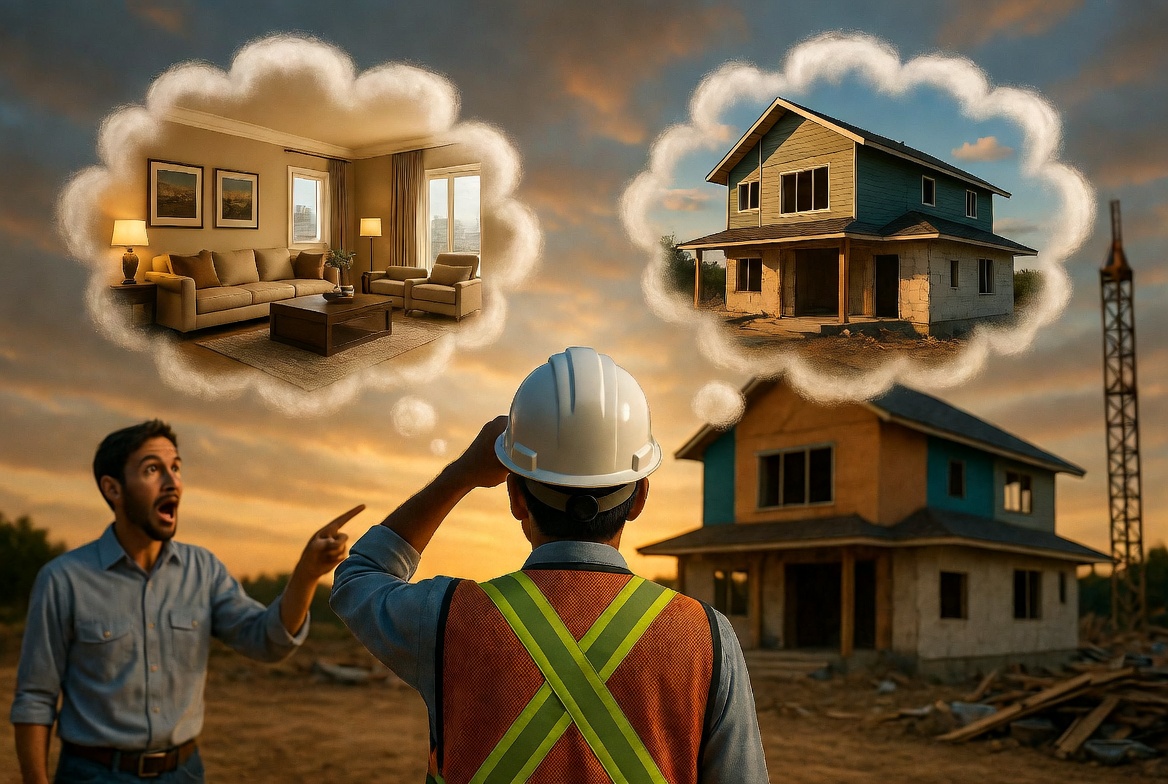
Many construction disputes do not begin because someone acted dishonestly.
They begin because two people believed they were talking about the same thing when, in reality, they were not.
An owner assumes a particular finish is included.
A contractor assumes it is an additional cost.
Neither realizes the misunderstanding until construction is already underway.
By then, frustration replaces excitement, trust begins to fade, and what could have been a simple conversation becomes a serious disagreement.
One lesson I have learned from construction disputes is this:
“Your contractor is not a mind reader—and neither are you!”
1. Assumptions Are Expensive
Construction projects involve thousands of individual decisions.
Every day, decisions are made about materials, finishes, dimensions, schedules, suppliers, workmanship, and countless other details.
Many of these decisions seem obvious to one party but completely unknown to the other.
That is where assumptions quietly begin to replace communication.
The owner thinks, “I assumed that was already included.”
The contractor thinks, “I assumed that wasn’t part of my scope.”
Both may honestly believe they are right.
“Construction disputes often begin with two reasonable people making different assumptions.”
2. Experience Creates Blind Spots
Experienced contractors spend years working on construction projects.
Because of that experience, they sometimes forget that many homeowners are building a house for the very first time.
What appears obvious to the contractor may be completely unfamiliar to the owner.
The reverse is equally true.
Homeowners sometimes assume that contractors automatically understand every personal preference, expectation, and design intention—even when those expectations were never clearly communicated.
Neither expectation is fair.
“Experience explains many things. It does not replace communication.”
3. Small Assumptions Become Big Problems
Many construction disputes do not begin with major structural defects or abandoned projects.
Sometimes they begin with surprisingly small issues that slowly grow into larger disagreements.
- “I thought that light fixture was included.”
- “I assumed premium paint was part of the quotation.”
- “I expected concealed wiring.”
- “I thought the kitchen cabinets were included.”
- “I didn’t know changing the layout would affect the price.”
- “I assumed the contractor would handle the permits.”
Each assumption may appear insignificant on its own.
Together, they can affect the budget, the schedule, the working relationship, and ultimately the success of the entire project.
“Construction projects are rarely damaged by a single misunderstanding. They are damaged by many small misunderstandings left unresolved.”
4. Good Communication Is Part of Good Construction
Many people think construction is primarily about concrete, steel, lumber, and labor.
Those are certainly important, but successful construction projects also depend on something less visible: communication.
A contractor may have an excellent team and years of experience. An owner may have carefully prepared plans and sufficient funding. Yet if important expectations are never discussed, misunderstandings can develop despite everyone’s good intentions.
The best construction professionals understand that communication is not an interruption to the work—it is part of the work.
Clarifying a question before work begins is almost always easier than correcting a mistake after the work has already been completed.
“Five minutes of clarification can save five days of rework.”
5. Never Assume. Always Clarify.
One habit can dramatically reduce misunderstandings on almost any construction project.
Whenever something is unclear, ask.
Owners should never hesitate to ask what is included in the quotation, whether a particular material has already been priced, or why additional costs are being proposed.
Likewise, contractors should never assume they already know what the owner wants. If there is uncertainty about finishes, layouts, specifications, or instructions, clarification should come before execution—not after.
Asking questions is not a sign of inexperience. It is often a sign of professionalism.
“Assumptions create disputes. Questions prevent assumptions. Ask questions to prevent disputes.”
6. The Best Contractors Explain. The Best Owners Ask.
The strongest working relationships are rarely built because one side knows everything.
They are built because both sides are willing to communicate openly and respectfully throughout the project.
Experienced contractors explain why certain decisions affect cost, schedule, or workmanship instead of assuming the owner already understands.
Likewise, engaged owners ask questions whenever they are uncertain instead of silently assuming that everything will somehow work out.
Neither approach guarantees a dispute-free project. However, it greatly reduces the likelihood that simple misunderstandings will grow into major disagreements.
“Good construction is built on concrete. Great construction is built on communication.”
Final Thoughts
Most construction disputes are not caused by anyone trying to deceive the other party.
Many begin because expectations were never clearly discussed, assumptions were never corrected, and questions were never asked.
Construction projects involve countless decisions from the day the first excavation begins until the final turnover. The more those decisions are discussed openly, the fewer surprises both parties are likely to encounter.
Whether you are building your first home or managing construction projects every day, one simple principle is worth remembering.
“Your contractor is not a mind reader—and neither are you!”
Clear expectations, honest conversations, and timely questions may not eliminate every construction problem. But they can prevent many disagreements from becoming construction disputes.
Related Articles
- Why Contractors Should Read Their Construction Contract Before Signing It
- Why Construction Problems Start Becoming Legal Disputes
- The Most Important Clause in Your Construction Contract Is the One You Hope You’ll Never Use
Planning a Construction Project?
Whether you are preparing to build your home or are already in the middle of a construction project, taking the time to clarify expectations early can help avoid unnecessary misunderstandings later.
If you need legal guidance on a construction contract or are already dealing with a construction dispute, you may send an inquiry using the form below.