
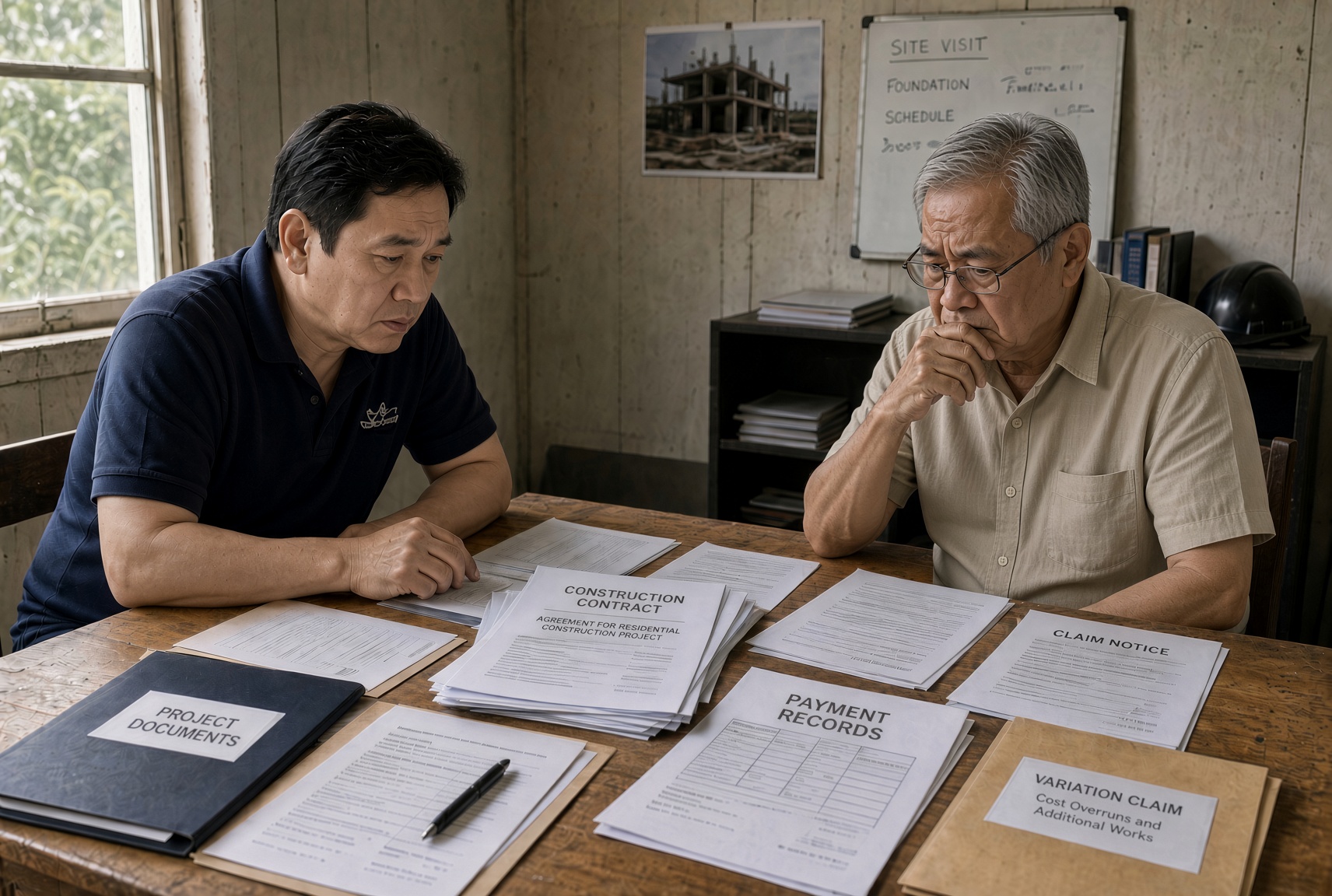
There is a phrase that many Filipinos would rather avoid hearing in a business dispute:
“Magkakasuhan na.”
For many people, the prospect of filing a case brings more than just the possibility of losing money or spending on legal fees.
It brings the prospect of conflict—internal and external.
It means confronting someone they may have trusted. It may mean damaging a personal relationship, losing a business connection, facing criticism from mutual friends, or being labelled as someone who is difficult to deal with.
And so, even when money is owed or a serious contractual obligation has been breached, the instinctive response is often to avoid taking things further.
You hear it all the time:
“Ayoko ng gulo.”
“Baka puwede pang pag-usapan.”
“Hintayin muna natin. Baka magbayad rin.”
“Huwag na nating palakihin.”
Sometimes, these are sensible reactions. A genuine willingness to compromise can save money, time, and relationships.
But sometimes, the same instinct to avoid conflict keeps people trapped in disputes that should have been addressed much earlier.
In the construction industry, this can be particularly costly.
A contractor may be owed millions of pesos but continue waiting for a client who repeatedly promises payment.
A homeowner may have paid a substantial amount to a contractor who has stopped working and disappeared, yet hesitate to consult a lawyer because of the expense and uncertainty of legal action.
Both may have legitimate grievances.
Both may have something worth protecting.
And both may be afraid of what happens if they finally decide to stand their ground.
“Sometimes, the fear of a dispute becomes more expensive than the dispute itself.”
This is a subject worth discussing because construction disputes are not just about contracts, money, and workmanship.
They are also about people: their relationships, their reputations, their fears, and their willingness to confront an uncomfortable situation.
So why do some owners and contractors hesitate to enforce their rights, even when the financial consequences of doing nothing continue to grow?
1. “Ayoko ng Gulo”: When Avoiding Conflict Becomes the Default Response
In the Philippines, maintaining harmonious relationships is important, whether within a family, among friends, or in business.
Concepts such as hiya and pakikisama may influence how some people approach confrontation. People can be reluctant to cause embarrassment, offend someone, or disrupt a relationship, even when they have a legitimate reason to raise a grievance.
Of course, not every Filipino thinks this way, and these cultural concepts do not explain every person’s decision. But for most people, the social discomfort of confronting another person can be just as intimidating as the legal process itself.
Consider a specialty contractor who has completed the work on a project but remains unpaid.
At first, the client asks for more time.
The contractor agrees.
Another payment date passes. The contractor follows up again.
The client apologizes, offers another explanation, and promises to settle the outstanding balance soon.
The contractor knows the situation cannot continue indefinitely. The business still has workers to pay, suppliers to settle, and other projects to finance.
Yet the contractor hesitates to take formal action.
“What if I damage the relationship?”
“What if this client tells other developers not to hire me?”
“What if I become known as a contractor who sues his clients?”
Now consider the homeowner whose contractor has stopped showing up at the site.
The house is unfinished. A substantial amount has already been paid. The owner has repeatedly tried to contact the contractor but has received little more than excuses and promises.
The owner considers seeking legal advice but worries about the cost, the time involved, and whether pursuing the matter will make an already stressful situation even worse.
So the owner waits a little longer.
Then a little longer again.
These are different situations, but they share a common problem.
The person who may have a legitimate claim is allowing the fear of confrontation to influence the decision about what to do next.
Avoiding unnecessary conflict is sensible.
But avoiding every difficult conversation, demand, or legal step is not necessarily the same as protecting a relationship or making a sound business decision.
“Keeping the peace is valuable. But peace that depends on one party continually accepting the loss is not necessarily a fair resolution.”
2. The Fear Is Not Always About Winning or Losing
When Filipinos hesitate to file a case, the immediate assumption is often that they are afraid of losing.
That is certainly one possibility. Litigation and arbitration involve uncertainty, and no responsible lawyer should promise a particular outcome.
But the reluctance to take action often goes deeper than that.
For a contractor, the concerns may include legal expenses, management time, collection prospects, and the possibility of losing future business from the client or related companies.
For a homeowner, the concerns may include the cost of lawyers, the emotional burden of a dispute, the possibility that the contractor has no money left to recover, and the fear of committing even more resources to an already expensive project.
There may also be a personal dimension. The contractor may have developed a relationship with the owner over months of work. The homeowner may have trusted the contractor with savings accumulated over many years.
Then there is the uncertainty of the process itself.
People hear stories about cases in the Philippines that drag on for years. They hear about expensive legal battles, endless hearings, and parties who spend more pursuing a claim than they ultimately recover.
Some of those concerns deserve serious consideration. The cost, duration, enforceability, and likely outcome of a claim are legitimate factors to assess before choosing a remedy.
But there is a difference between carefully evaluating those risks and assuming that pursuing a legal remedy is always futile.
A contractor who is owed a substantial amount should evaluate the commercial consequences of pursuing the claim against the consequences of continuing to wait.
A homeowner who has suffered a significant loss should likewise assess the available remedies, the evidence, the likely costs, and whether a judgment or settlement could realistically be enforced.
The decision should be based on an informed assessment of the situation—not simply on fear of what might happen.
“You do not have to be eager to sue. But you have to know the cost of not acting.”
3. When Patience Becomes a Problem
Patience is not a weakness.
In construction, it can be commercially sensible to give a client time to arrange payment, allow a contractor an opportunity to correct defective work, or give the parties a chance to resolve a misunderstanding before it becomes a formal dispute.
Not every delay in payment is bad faith. Not every construction problem requires a lawyer. And not every disagreement needs to end in litigation or arbitration.
The problem begins when patience becomes indefinite.
A contractor keeps accepting promises without any meaningful progress toward payment.
A homeowner continues waiting for a contractor who repeatedly fails to return to the project.
A party agrees to one more extension, then another, without reassessing whether the other side is genuinely trying to resolve the matter.
At some point, the question changes from “Should I give the other party more time?” to “What reasonable basis do I have for believing that more time will change anything?”
This is where people can lose sight of the difference between being reasonable and simply postponing a difficult decision.
An amicable settlement requires more than one party’s willingness to wait. It ordinarily requires meaningful participation from both sides, a realistic proposal, and some indication that the parties intend to resolve the issue.
Without those things, repeated promises may merely extend the period of uncertainty while the financial consequences continue to accumulate.
There is also a practical risk in waiting too long without obtaining advice.
Depending on the claim, the contract, and the applicable law, delay can affect available remedies, the preservation of evidence, the ability to trace payments or assets, and compliance with contractual or statutory deadlines.
That does not mean everyone should immediately file a case. It means that deciding to wait should itself be a conscious, informed decision rather than a default response to discomfort.
“Give the other party a fair opportunity to resolve the problem. But do not confuse an opportunity with an unlimited extension.”
4. The Contractor Who Is Afraid to Sue the Client
Consider a specialty contractor who has completed the work, submitted the billings, and followed up repeatedly for payment.
The client acknowledges the outstanding balance but keeps asking for more time.
At first, the contractor is understanding. The client has other projects, cash flow can be difficult, and the contractor wants to preserve the relationship.
But weeks turn into months. The amount owed continues to grow, and the contractor is effectively financing the client’s business while struggling to meet his own obligations.
Eventually, someone suggests consulting a lawyer.
The contractor hesitates.
“What if the client gets offended?”
“What if I lose future projects?”
“What if other developers hear about this?”
“What if I spend money pursuing the claim and recover nothing?”
These are not necessarily irrational concerns. Contractors must think about commercial relationships, legal costs, recoverability, and the time required to resolve a dispute.
But those considerations should be weighed against the consequences of doing nothing.
An unpaid receivable is not merely an accounting entry. It can affect payroll, supplier payments, working capital, the ability to accept new projects, and the financial stability of the contractor’s business.
There is also a difficult reality that contractors must recognize: a client who has become accustomed to receiving repeated extensions without meaningful consequences may have little incentive to prioritize payment.
That does not mean every late-paying client is acting in bad faith. It means that patience alone cannot guarantee a resolution.
“To us Filipinos, protecting a business relationship is important. But remember, protecting the business itself is important too.”
A contractor does not have to rush into a legal dispute. But the contractor should know when continued accommodation is no longer commercially sensible.
Sometimes, a formal demand or a consultation with a lawyer is enough to clarify the parties’ positions and encourage a serious settlement discussion.
And sometimes, the contractor must consider more formal remedies.
The important thing is to make that decision based on the facts, the contract, the evidence, and the realistic prospects of recovery—not simply on the fear of being labelled as someone who likes to sue.
5. The Homeowner Who Is Afraid to Pursue an Absent Contractor
Now consider the other side of the problem.
A homeowner hires a contractor to build a family home. The owner pays substantial amounts as construction progresses, trusting that the project will be completed as promised.
Then the work slows down.
The contractor becomes difficult to reach.
Workers stop reporting to the site.
The owner receives explanations and assurances, but the promised resumption of work never happens.
At some point, the homeowner begins to suspect that the contractor may never return.
Yet the prospect of taking legal action feels overwhelming.
The owner has already spent a substantial amount on the house. There is still a project to complete, a family to accommodate, and perhaps a loan to pay. The thought of spending even more money on lawyers and proceedings can feel unbearable.
Friends and relatives may offer conflicting advice.
“Kasuhan mo na!”
“Huwag na. Sayang lang ang pera.”
“Matagal ang kaso.”
“Baka wala ka rin makuha kahit manalo ka.”
The homeowner is left trying to decide whom to believe and what to do next.
Some of these warnings may point to genuine risks. A successful legal claim does not automatically guarantee that the other party has sufficient assets to satisfy a judgment or arbitral award. Legal proceedings also involve costs, time, and uncertainty.
But none of those considerations establishes that the homeowner should simply give up.
The homeowner’s immediate objective should be to understand the actual position.
What does the contract say?
How much has been paid?
What work has actually been completed?
What remains unfinished?
What evidence exists of the contractor’s commitments and subsequent conduct?
What contractual and legal remedies may be available?
What is the realistic cost of completing the project, and what can reasonably be recovered?
“Before deciding that pursuing a claim is not worth it, understand what you would be giving up by walking away.”
Obtaining legal advice does not commit the homeowner to filing a case. It allows the homeowner to assess the situation before making a decision that may affect a substantial financial investment.
The same principle applies to contractors with unpaid claims.
In both situations, the objective is not to litigate at all costs. It is to stop making important decisions based solely on fear and uncertainty.
6. Seeking Legal Advice Does Not Mean You Have Decided to Sue
One reason Filipinos postpone consulting a lawyer is that we try to convince ourselves that something can still be done. We also believe that consulting a lawyer means the dispute has already escalated.
We imagine an immediate demand letter, an aggressive confrontation, and eventually a case filed before a court or tribunal.
That is not necessarily how the process begins.
A lawyer can first help the parties understand their contractual rights and obligations, identify the issues in dispute, assess the available evidence, and evaluate the practical options.
Depending on the circumstances, those options may include further negotiation, a formal demand, a structured settlement proposal, mediation, arbitration, or court proceedings where appropriate.
Sometimes, the legal review reveals that a party’s position is weaker than initially believed. In other cases, it confirms that a genuine claim exists and that continued informal discussions are unlikely to resolve it.
Either way, the information helps the party make a more informed decision.
There is a difference between threatening legal action at every opportunity and understanding when legal remedies may be necessary.
A measured approach does not require unnecessary hostility. A contractor can remain professional while insisting on payment. An owner can seek recovery for a serious contractual breach without turning the dispute into a personal vendetta.
“Consulting a lawyer is not the same as deciding to file a case. Sometimes, it is simply the first step toward understanding your options.”
And when an amicable settlement is still possible, understanding the legal position can actually make negotiations more productive. Both parties can discuss concrete proposals with a clearer appreciation of their respective rights, risks, and alternatives.
7. A Construction Dispute Does Not Always Have to Go to a Regular Court
Another reason Filipinos fear pursuing a construction claim is that they imagine only one option: filing a case in court and preparing for a long legal battle.
But construction disputes in the Philippines have a specialized dispute-resolution framework.
For appropriate disputes, one important avenue is arbitration before the Construction Industry Arbitration Commission, commonly known as the CIAC.
Under Section 4 of Executive Order No. 1008, the CIAC has original and exclusive jurisdiction over covered disputes arising from or connected with construction contracts in the Philippines, including disputes involving payment, contractual obligations, delays, defects, and changes in contract cost.
For the CIAC to exercise jurisdiction, however, the parties must agree to submit the dispute to voluntary arbitration. That agreement may be contained in the construction contract or made through a subsequent agreement to arbitrate.
The Supreme Court discussed the significance of this agreement in Philippine Textile Research Institute, et al. v. Court of Appeals and E.A. Ramirez Construction, Inc. (G.R. Nos. 223319 and 247736, October 9, 2019).
The Court explained that an arbitration clause in a construction contract, or a subsequent agreement to submit the dispute to arbitration, may establish the basis for CIAC jurisdiction over a covered construction controversy.
For an owner or contractor, this matters because a properly chosen dispute-resolution mechanism can provide a defined process for resolving a construction controversy without commencing an ordinary civil action in a regular trial court.
Arbitration is still a formal legal process. It involves procedural requirements, costs, preparation, and the possibility of an adverse outcome. It is not a guarantee of a quick, inexpensive, or successful resolution.
But it is an important option to understand before assuming that the only choices are to keep negotiating indefinitely or to file a regular court case.
“Understanding your options can make the difference between being afraid of a dispute and knowing how to address it.”
This is one reason the dispute-resolution clause deserves careful attention when a construction contract is being prepared.
The time to discuss how a future dispute will be resolved is before the parties are already arguing over unpaid billings, defective work, delay, or an unfinished project.
8. The Arbitration Clause: A Decision Best Made Before the Dispute
When people sign a construction contract, they naturally focus on the price, scope of work, materials, payment schedule, and completion date.
The dispute-resolution clause is easy to overlook because neither party expects the relationship to end in disagreement.
But a properly drafted arbitration clause can establish in advance how covered construction disputes will be handled if the relationship breaks down.
For contracts involving construction in the Philippines, this can mean considering whether disputes should be submitted to the CIAC, provided the dispute falls within its jurisdiction and the parties are bound by the necessary agreement to arbitrate.
Without an existing arbitration agreement, the parties may still agree to submit a dispute to arbitration later. But that requires agreement at a time when the relationship may already have deteriorated.
One party may want arbitration. The other may refuse.
At that point, a mechanism that could have been agreed upon calmly before construction began becomes another issue for the parties to argue about.
This is not an argument that every construction dispute should immediately be arbitrated. The appropriate process depends on the contract, the nature of the dispute, the parties’ agreement, and the applicable law.
The point is that owners and contractors should make a deliberate decision about dispute resolution rather than leave it unexamined until they need it.
“The best time to agree on how a construction dispute will be resolved is before either party has a reason to refuse.”
A good dispute-resolution clause cannot prevent every conflict. Nor does it eliminate the cost and uncertainty of pursuing a claim.
What it can do is give the parties a pre-agreed framework for addressing covered disputes, instead of forcing them to begin by arguing about the process itself.
9. Not Every Dispute Should End in a Case. But Not Every Dispute Can Be Settled.
It is important to make one thing clear.
The answer to the fear of litigation is not to encourage everyone to file a case at the first sign of disagreement.
Construction projects involve long-term commercial relationships. There are times when a misunderstanding can be corrected, a payment schedule can be renegotiated, defective work can be remedied, or a reasonable compromise can save both parties considerable time and money.
When a genuine opportunity for settlement exists, pursuing it can be the sensible decision.
A contractor may prefer to receive an agreed payment in installments rather than spend additional resources pursuing a claim. A homeowner may prefer to allow a contractor to correct genuine defects rather than immediately terminate the contract and pay someone else to finish the work.
But a settlement requires more than one party’s willingness to compromise.
It requires meaningful participation from both sides.
A contractor who repeatedly promises to return to an abandoned project but never does so is not meaningfully resolving the problem.
A client who repeatedly acknowledges an outstanding billing but keeps postponing payment without following through is not necessarily making progress toward settlement.
At some point, the parties must look beyond what has been promised and evaluate what has actually happened.
This is where a disciplined approach matters.
Set reasonable deadlines. Ask for concrete commitments. Evaluate proposed payment arrangements realistically. Determine whether the other party is genuinely cooperating. And understand what contractual or legal options remain available if the discussions fail.
“An amicable settlement is worth pursuing. Endless waiting without meaningful progress is not the same thing as settlement.”
In the Philippines, there is no universal number of days after which negotiation must stop. The appropriate decision depends on the circumstances, the contract, the amount involved, the conduct of the parties, and the urgency of protecting the claim.
But there should come a point when continued negotiation is evaluated based on results rather than promises alone.
10. Before You Decide to Sue—or Give Up—Ask These Questions
If you are an owner or contractor involved in a construction dispute, you do not have to decide immediately whether to file a case.
But you should avoid making that decision based solely on fear, frustration, or the advice of people who may not know the details of your situation.
Start by asking yourself the following questions.
- What exactly is my claim? Identify the unpaid amount, contractual breach, unfinished work, alleged defect, or other issue that needs to be resolved.
- What does the contract say? Review the relevant obligations, payment provisions, termination rights, notice requirements, and dispute-resolution clause.
- What evidence supports my position? Gather the contract, billings, payment records, relevant correspondence, progress records, and other materials that may establish what happened.
- Has the other party made a concrete effort to resolve the dispute? Distinguish actual performance from repeated verbal assurances.
- What are the realistic costs and benefits of pursuing the claim? Consider legal expenses, time, potential recovery, available assets, and the practical consequences of continuing to wait.
- What dispute-resolution mechanism applies? Determine whether the contract provides for CIAC arbitration, mediation, or a different process, and assess whether that mechanism applies to the dispute.
- Is there a deadline I must consider? Obtain advice regarding applicable prescriptive periods, contractual notice requirements, and procedural deadlines rather than assuming that negotiations automatically protect the claim.
These questions do not automatically lead to litigation or arbitration.
Sometimes, they reveal that further negotiation is appropriate. Sometimes, they help the parties find a reasonable settlement. In other situations, they reveal that the risks of continuing to wait may be greater than the risks of pursuing a formal remedy.
The objective is to make an informed decision.
You may ultimately decide not to pursue a claim because the costs outweigh the likely recovery. You may decide that a settlement is preferable to a prolonged dispute. Or you may conclude that formal proceedings are necessary to protect your rights.
Any of those decisions can be reasonable, depending on the facts.
“The important thing is not that you file a case. It is that you understand your options before deciding what to do.”
11. You Can Be Reasonable Without Being Defenseless
Perhaps this is the most important distinction.
You can be patient without waiting indefinitely.
You can be accommodating without accepting every excuse.
You can pursue an amicable settlement without giving up your contractual rights.
And you can enforce those rights without being unnecessarily hostile.
For contractors, this means treating the collection of legitimate receivables as part of running a business. Maintaining good client relationships matters, but so do cash flow, financial stability, and the ability to pay employees and suppliers.
For owners, it means taking reasonable steps to protect a substantial investment. If a contractor has genuinely breached the agreement, the owner should understand the available remedies rather than assume that seeking legal advice will automatically lead to an expensive lawsuit.
For both parties, it means recognizing that professional conduct and the enforcement of legal rights are not contradictory.
A well-founded demand for payment is not automatically unreasonable. A properly supported claim for defective or unfinished work is not automatically vindictive. And a party who insists on compliance with an agreement is not necessarily looking for a fight.
“You can pursue a peaceful resolution without surrendering your right to pursue a legal remedy.”
That is the balance worth striving for.
Not a culture of litigation for its own sake, but a culture in which people understand their rights, take their obligations seriously, and know when an informal resolution is no longer enough.
Final Thoughts
For Filipinos, construction disputes can be financially painful and personally exhausting.
That is precisely why Filipinos want to avoid them.
A contractor does not want to lose a client. A homeowner does not want to spend years dealing with a legal dispute. Both may worry about expenses, uncertainty, damaged relationships, and the possibility that pursuing a claim will create more problems than it solves.
Those concerns deserve to be taken seriously.
Amicable settlement has an important place in construction. Negotiation can preserve business relationships, reduce costs, and allow parties to reach practical solutions that a formal proceeding might not produce in the same way.
But an unwillingness to confront a problem can also allow it to grow.
Unpaid billings accumulate. Abandoned projects remain unfinished. Promises go unfulfilled. Evidence becomes harder to gather. And opportunities to protect a claim may be lost.
This is why I believe the goal should not be to make owners and contractors more eager to file cases.
The goal should be to help them become more deliberate about resolving disputes.
Try to settle when settlement is realistic.
Negotiate when there is a genuine willingness to resolve the matter.
Understand your contract and your legal options before deciding what to do.
And when a legitimate claim cannot be resolved amicably, do not allow the fear of being labelled difficult, confrontational, or litigious to make the decision for you.
“You do not have to want a legal dispute. But you should not have to accept an unresolved injustice simply because you are afraid of one.”
For owners and contractors alike, the real objective is not to win every disagreement or to take every dispute to court.
It is to protect legitimate interests, meet contractual obligations, and resolve problems through the most appropriate means available.
Sometimes that means finding common ground.
Sometimes it means walking away from an unproductive negotiation.
And sometimes it means pursuing formal remedies through the appropriate dispute-resolution process, including CIAC arbitration where applicable.
“Avoid unnecessary disputes. Pursue reasonable settlements. But never confuse the desire for peace with the obligation to tolerate an unresolved problem indefinitely.”
Related Articles
- The Most Important Clause in Your Construction Contract Is the One You Hope You’ll Never Use
- When Construction Problems Start Becoming Legal Disputes
- Why Construction Claims Fail Even When the Contractor Is Right
- What to Do If You Are Not Paid in a Construction Project
- Force Majeure in Construction: When Is a Delay Really Beyond the Contractor’s Control?
Dealing With a Construction Dispute?
Whether you are a contractor dealing with unpaid billings or a property owner facing an unfinished project, a contractual disagreement, or another construction-related problem, understanding your legal position can help you make more informed decisions about the way forward.
If you need legal guidance concerning a construction claim, contractual breach, or dispute-resolution options, you may send an inquiry using the form below.